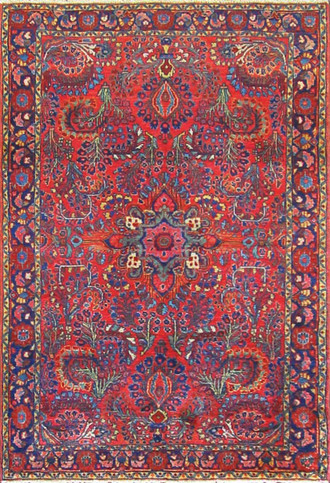
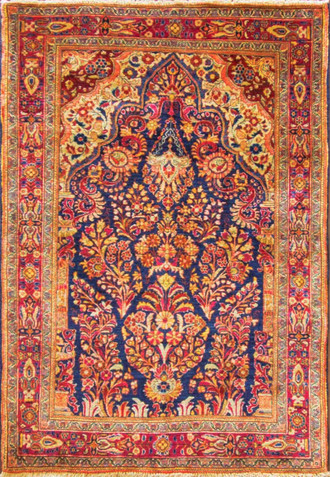
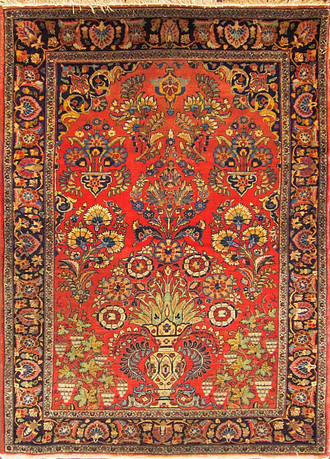
Made in Persia, circa 1920s, in perfect condition.
The source of this important provenance has been in the village of Sarouk. North of Arak (formerly Sultanabad). Sarouks are known to be of high quality. The pile is usually higher than the average Persian rug and therefore Sarouks are rather heavy and solid rugs, the wool being used is high quality durable wool. "Mohajeran" or "Mahajiran" is the name of a village west of Arak.
lustrous wool Persian Mohajeran Sarouk.
The source of this important provenance has been in the village of Sarouk. North of Arak (formerly Sultanabad). Sarouks are known to be of high quality. The pile is usually higher than the average Persian rug and therefore Sarouks are rather heavy and solid rugs, the wool being used is high quality durable wool. "Mohajeran" or "Mahajiran" is the name of a village West of Arak.
Sarouk, a small village and its neighboring villages in northwestern Iran are the source of large numbers rugs imported into the United States. The Sarouk carpet production came into existence around 1880 specifically for the European and North American markets. Before 1920s the Sarouk design was similar to that of the rug weaving centers of Ferahan and Tabriz. Most Sarouk rugs followed a very distinctive design and it depended on floral sprays and bouquets. Mohajeran refers to another village where rugs are produced
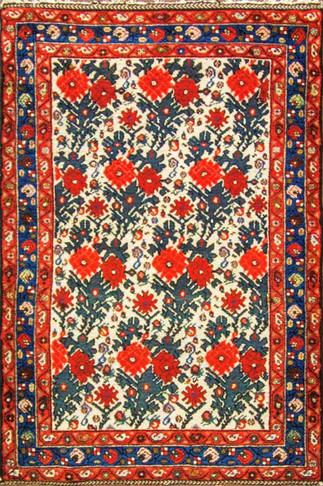
A beautiful and finely woven antique Persian Bakhtiari rug featuring a rare and highly decorative all-over floral design on a luminous ivory field. Unlike the more commonly encountered garden-panel (Kheshti) Bakhtiari rugs, this example displays an elegant arrangement of stylized blossoms, palmettes, and angular leafy vinery woven in a harmonious repeating pattern across the field.
The design is rendered in rich shades of madder red, deep indigo blue, soft sky blue, ivory, rose, and camel, creating a striking contrast that gives the rug exceptional visual appeal.
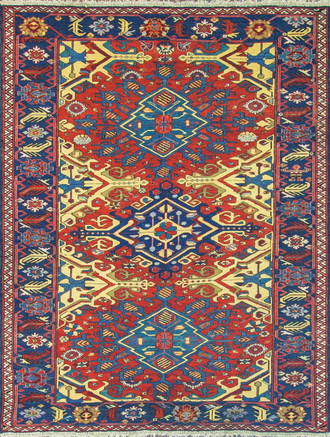
Precise drawing applied to highly abstract or stylized geometric patterns, using a rich and varied palette.
Soumaks are flat woven rugs. Their technique is related to that of Kilims, but it is somewhat more complex.
It is more durable as floor covering. As opposed to Kilim technique which consists of compacted weft facing simply running over and under the vertical wraps, Soumak weave runs the yarns around the warps in a serpentine pattern, over two, back one, over two back one, and so forth.
The design large polygonal medallions, often in the shape of diamonds or stars.
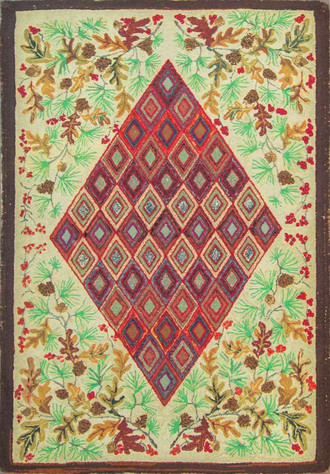
The production of Hooked rugs began in the 1840s. Measures: 3.3" x 4.9". The materials consisted of linen, flax, hemp, and eventually imported Indian jute. The most common design found in the earliest rugs was floral, expanding to include scenes and even an images of peoples’ pets. Hooked rugs have a variable pile, depending upon the lengths of yarn used, and the designs are increasingly complex. These rugs are flat on the bottom and not reversible. Hand made by housewives and local craft makers, American hooked rugs are folksy works of art that are functional too.
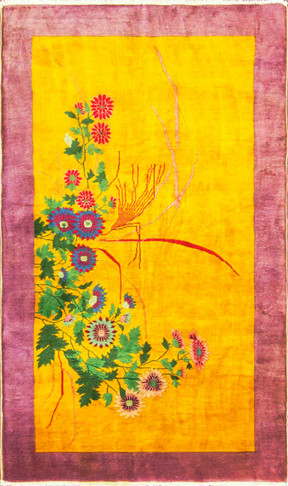
This wonderful Art Deco carpet was made in China, circa 1920s. Walter Nichols was great American rug producer (the Art Deco rugs which he did not originate them) in Tientsin. The rugs made of wool and silk with bold vibrant colors and the pattern are pictorial scenes and trees, birds, clouds, mountains, dragons, butterfly and flowers. The production of Art Deco rugs started from 1910s-1950s and mostly with western influence.
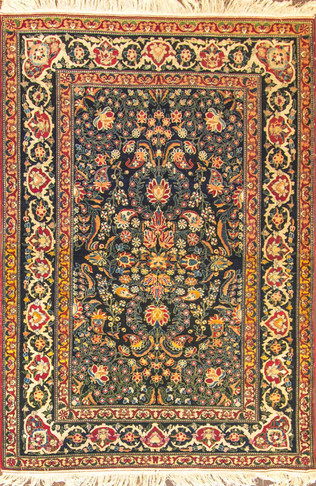
The Iranian city of Isfahan has long been one of the centres for production of the famous Persian carpet. Isfahani carpets are known for their high quality. The most famous workshop in Isfahan is Seirafian. Weaving in Isfahan flourished in the Safavid era. But when the Afghans invaded Iran, ending the Safavid dynasty, the Craft also became stagnant. The high knot density antique carpets in which Isfahan excelled continued to be woven in the late 19th and 20th centuries, maintaining the original inspiration and attention to refinement and detail.