Made in south-eastern Caucasus, bordering on north-western Iran.
This rug foundation and pile both are wool.
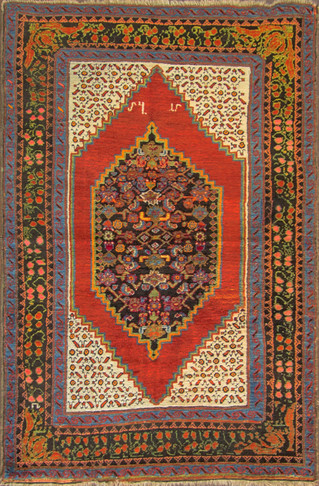
The design is significantly unique, specially the black border and the center medallion, therefore it is unique and important rug from every aspect.
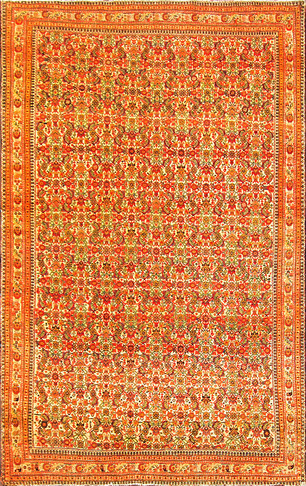
This exceptional antique Persian Feraghan, woven circa 1880, is a remarkably fine example of the classic all-over Herati design that established Feraghan as one of the most esteemed weaving centers of 19th-century Persia.
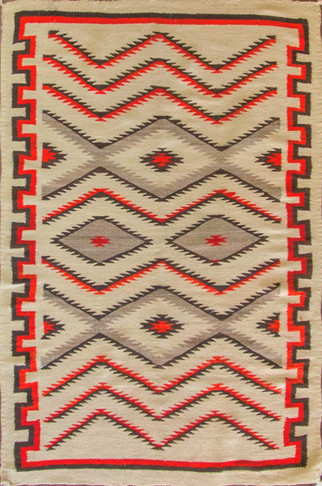
A typical Navajo rug has approximately 30 wefts to the linear inch. A two grey hills from Toadlena average about 45. The finer pieces frequently have upwards of 80. When a textile has 80 or more wefts per inch, it is considered a tapestry, not a rug. The most famous weaver of these textiles was Daisy Taugelchee (1909-1990), who wove upwards of 115 wefts per inch, which created the most finely woven Navajo tapestries anywhere.
The weavers preferred to use natural wool from their sheep rather than the commercially produced wool used by other Navajo weavers.
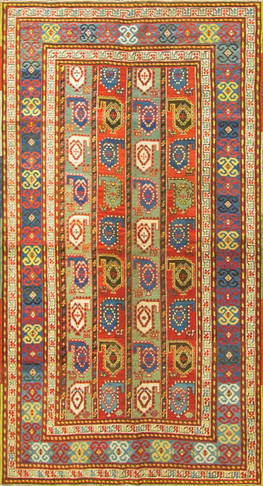
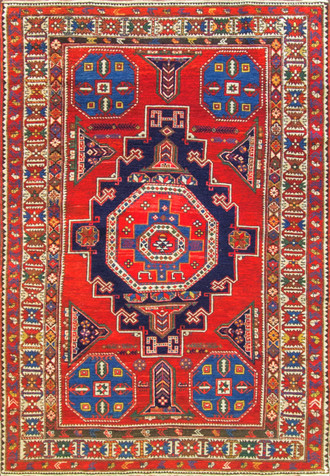
Highly unusual design antique colorful Kazak rug.
The Caucasus is bounded by the rugged mountains and lush valleys of Armenia, Azerbaijan and Georgia. This cultural melting pot was populated by Armenian dyers and weavers, Azeri Turks, groups from the Northern Caucasus and minorities from the surrounding areas. The Kazak rugs of the Caucasus are distinctive and individual. Geometric people and animals, symbolic motifs, dramatic medallions, crenellated fence borders, angular cloud-bands and graphic latch.
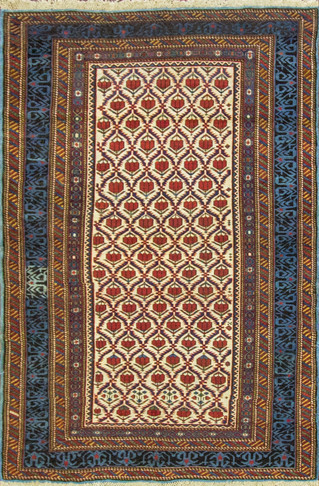
Antique Caucasian Shirvan Rug – Boteh Design, Late 19th Century
Size: 51" x 80"
A finely woven antique Caucasian rug from the Shirvan region of Azerbaijan, dating to the late 19th century.
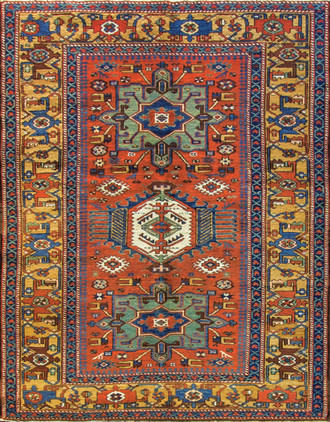
Fine Karaja rug in perfect condition with beautiful colors and design, circa 920.
The dyes used in these rugs are 100% natural. Karaja rugs have very unique patterns that are different from the other rugs produced in this region. The field is covered with a repeating medallion design and all of the medallions have a very simple, geometric shape. The only other types of rug that features this repeating medallion design are those produced by the Turkamen tribe, who originate in the northeastern region of Iran. The bold motifs and patterns predominantly resemble insects, leaves and crabs.
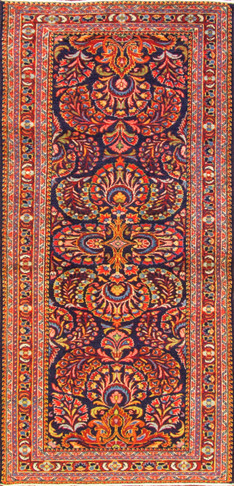
Beautiful colors with fine quality, circa 1920. Produced south of the city of Arak by Armenians in Persia, handmade Lilihan rugs are known for their design. Traditionally designed with a curvilinear lattice with traditional floral motifs these rugs also feature geometric designs. The primary characteristic of Lilihan rugs is the abundant use of pink although khaki and brown ornament the salamander background. Made with a long pile, these rugs are often mid-sized and favored by American tastes.
ABOUT THE SELLER
The historic Khanate or administrative district of Shirvan produced many highly decorative antique rugs that have a formality and stylistic complexity that is found in few rugs from the Caucasus. The depth of colors, the complexity of the composition and the phenomenal patterns featured in antique Shirvan rugs set them apart from those produced in other regions of the Caucasus.