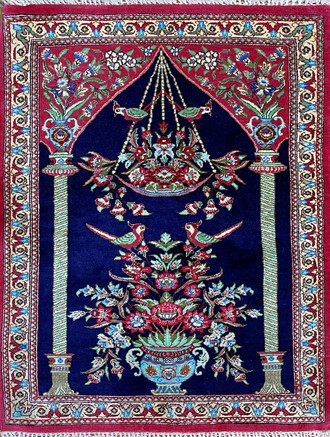
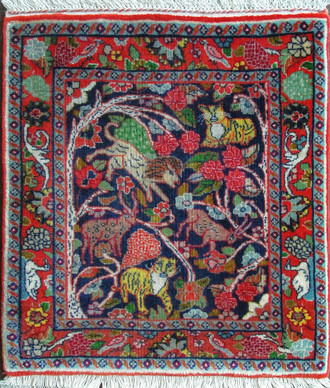
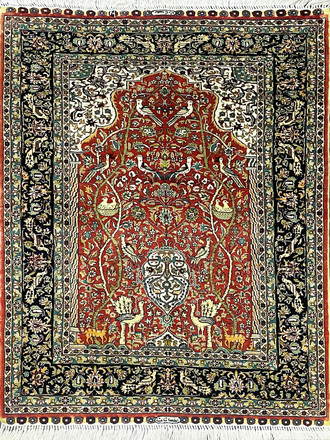
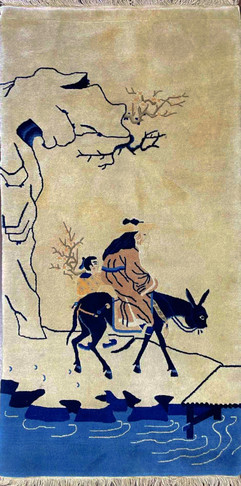
This is an authentic handmade rug. It was made in China around the 1940s . The overall color pallet is ivory over. The materials are wool pile with cotton foundation. The colors are from vegetable dyes, and the general pattern is pictorial design. The overall condition is excellent, especially when its age is taken into consideration. There are no tears, breaks or holes. The side bindings are intact and original. The ends are bound. The pile is high . The rug has been professionally washed.
This rug is in excellent condition, cleaned and no stained, the ends and bindings of the rug are intact as original and there has not been any repairs. There are no tears, breaks or holes.
The materials are from vegetable dyes wool.
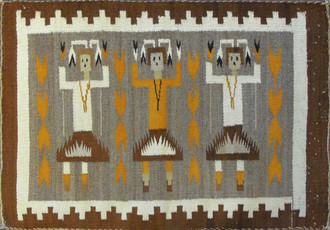
Handmade Navajo tree figure Yei rug. The weave is tight, the piece has a good weight and the design is clear with eleven different colors. The image is of three female Yei goddesses protected by a Rainbow Guardian. The rug was probably made in the early 20th century.
Construction: Fine wool with silk highlights on cotton foundation
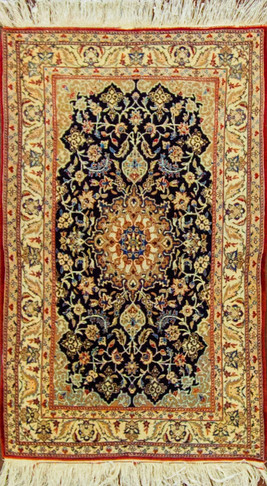
This is a very fine Persian Nain Tudeshk rug, woven in the village of Tudeshk, located southeast of Nain. Tudeshk rugs are often confused with Nains because of their exceptional fineness, elegant drawing, and sophisticated color palette, but they typically exhibit a slightly more individual village character.
An elegant and finely woven Persian Nain Tudeshk runner featuring a deep midnight-blue field centered by an intricate ivory and camel medallion.
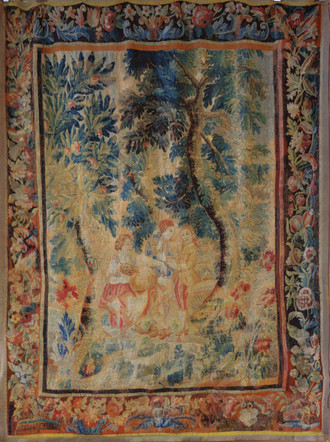
This antique European tapestry depicts an idyllic pastoral gathering set within a richly woven verdure landscape of towering trees, flowering foliage, and woodland vegetation. Three elegantly dressed figures are portrayed beneath a canopy of dense botanical forms, rendered in softly aged tones of deep blue, sage green, ivory, terracotta, rose, and muted gold.
The tapestry is framed by an elaborate floral border filled with scrolling vines, blossoms, and decorative foliage characteristic of Northern European verdure weaving traditions.
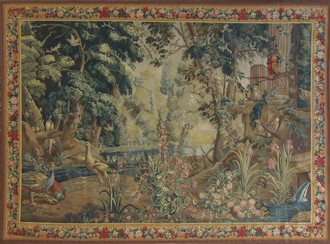
Tapestry, French design very fine, 9'3" x 6'8".
This magnificent tapestry was handcrafted by skilled artists using the exact same method of weaving used in 16th century.
It was woven using finest grade of wool and silk.
Being 100% handmade and having more than one hundred shade of color.
Excellent condition.