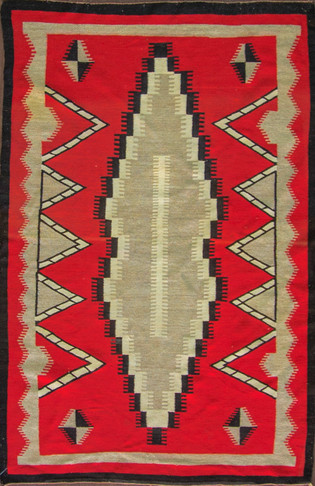
45" x 75" Unusual Eye-dazzler Navajo Rug, c-1890 in excellent condition,
A classic Navajo rug circa 1890's in excellent condition. Homespun native wool with natural wool colors, vegetal dye.
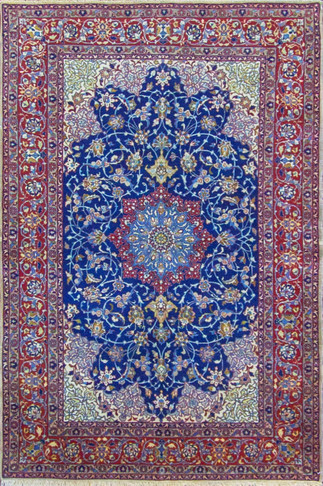
The Iranian city of Isfahan has long been one of the centres for production of the famous Persian carpet, 3'7" x 5'4". Isfahani carpets are known for their high quality. The most famous workshop in Isfahan is Seirafian.
Weaving in Isfahan flourished in the Safavid era. But when the Afghans invaded Iran, ending the Safavid dynasty, the craft also became stagnant.
The high knot density antique carpets in which Isfahan excelled continued to be woven in the late 19th and 20th centuries, maintaining the original inspiration and attention to refinement and detail.
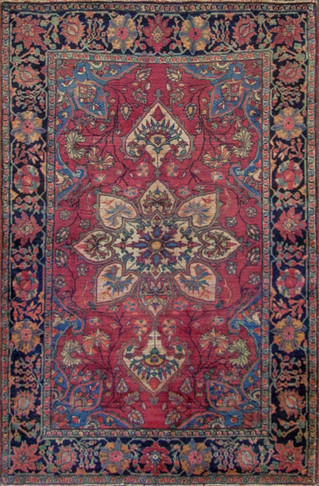
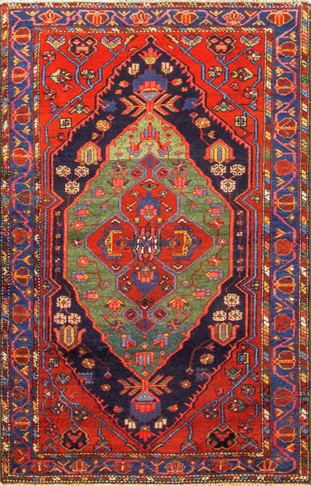
The Feraghan district area have a long history of rug and carpet weaving in the 19th century, many British companies opened oriental carpet factories and began to produce fine Persian Feraghan rugs and carpets for export to Europe. Antique Feraghan carpets and rugs are prized for their sturdy construction and their fine quality.
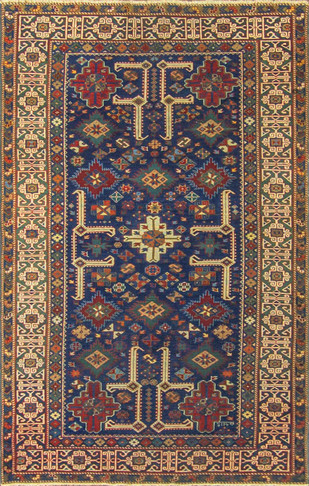
Historic Khanate or administrative district populated by the Lezghi people and Azeri Turks. Located in present-day Azerbaijan, the city of Kuba produced some of the most distinctive and finely executed Caucasian rugs. They are beautifully and richly colored, and they combine cryptic Caucasian symbols with exceptionally decorative motifs. Regional Sub-types, such as Konagkend rugs, are often lumped together with the diverse Kuba group
Unusual Persian Bakhtiari rug.
Beautiful and unusual two sade of solid green medallion in the center of this charming Bakhtiari rug.
The Bakhtiari tribe, based in Chahar Mahaal and Bakhtiari, is well-known for their rugs and weavings. They have been weaving rugs exported around the globe since the early 19th century
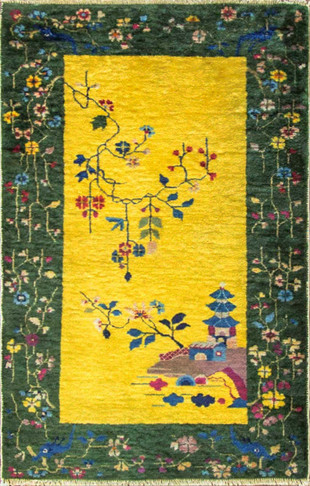
This wonderful Art Deco carpet was made in China, circa 1910s or 1920's. It has purchased from a nice home in New York. Walter Nichols was great American rug producer (the Art Deco rugs which he did not originate them) in Tientsin. The rugs made of wool and silk with bold vibrant colors and the pattern are pictorial scenes and trees, birds, clouds, mountains, dragons, butterfly and flowers. The production of Art Deco rugs started from 1910s-1950s and mostly with western influence.
The most beautiful colors in top condition and stunning design.
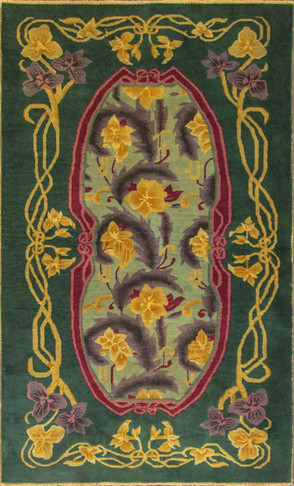
This wonderful Art Deco carpet was made in China, circa 1910s or 1920s. It has purchased from a nice home in Pennsylvania . Walter Nichols was great American rug producer (the Art Deco rugs which he did not originate them) in Tientsin. The rugs made of wool and silk with bold vibrant colors and the pattern are pictorial scenes and trees, birds, clouds, mountains, dragons, butterfly and flowers. The production of Art Deco rugs started from 1910s-1950s and mostly with western influence.
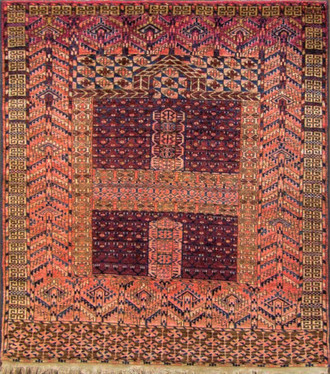
Almost all Turkmen rugs were produced by nomadic tribes almost entirely with locally obtained materials, wool from the herds and vegetable dyes, or other natural dyes from the land. They used geometrical designs that varied from tribe to tribe; most famous are the Yomut, Ersari, Saryk, Salor, and Tekke. Irregularities — considered part of the charm by many rug collectors — were fairly common since natural materials varied from batch to batch and woollen warp or weft may stretch, especially on a loom that is regularly folded up for transport and set up a new at another camp.