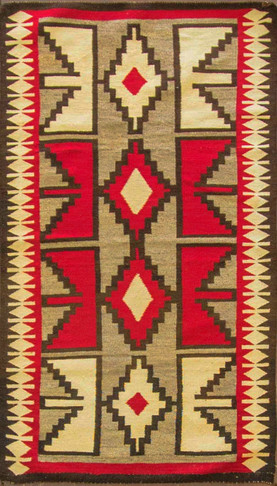
A typical Navajo rug has approximately 30 wefts to the linear inch. The finer pieces frequently have upwards of 80. When a textile has 80 or more wefts per inch, it is considered a tapestry, not a rug. The most famous weaver of these textiles was Daisy Taugelchee (1909-1990), who wove upwards of 115 wefts per inch, which created the most finely woven Navajo tapestries anywhere.
The weavers preferred to use natural wool from their sheep rather than the commercially produced wool used by other Navajo weavers.
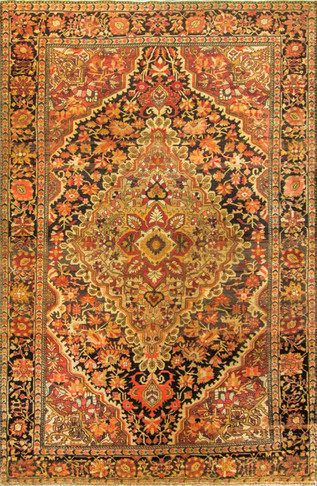
The Feraghan district area have a long history of rug and carpet weaving in the 19th century, many British companies opened oriental carpet factories and began to produce fine Persian Feraghan rugs and carpets for export to Europe. Antique Feraghan carpets and rugs are prized for their sturdy construction and their fine quality.
The Feraghan district area have a long history of rug and carpet weaving in the 19th century, many British companies opened oriental carpet factories and began to produce fine Persian Feraghan rugs and carpets for export to Europe. Antique Feraghan carpets and rugs are prized for their sturdy construction and their fine quality
One of the top high end Persian carpet maker.
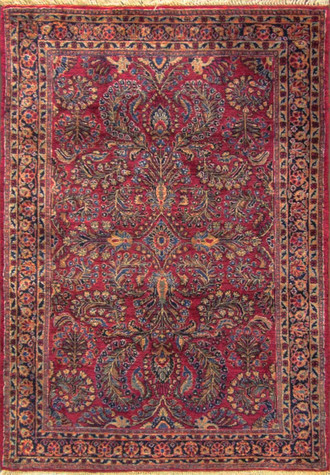
The source of this important provenance has been in the village of Sarouk. North of Arak (formerly Sultanabad). Sarouks are known to be of high quality. The pile is usually higher than the average Persian rug and therefore Sarouks are rather heavy and solid rugs, the wool being used is high quality durable wool. "Mohajeran" or "Mahajiran" is the name of a village West of Arak.
Made in Persia, circa 1920s, in perfect condition.
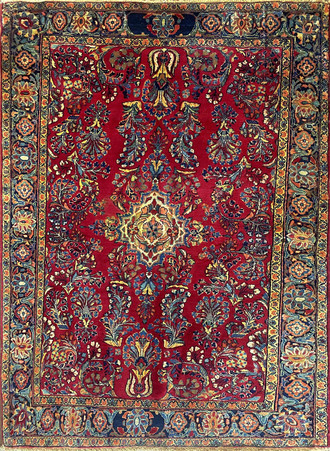
The source of this important provenance has been in the village of Sarouk. North of Arak (formerly Sultanabad). Sarouks are known to be of high quality. The pile is usually higher than the average Persian rug and therefore Sarouks are rather heavy and solid rugs, the wool being used is high quality durable wool. "Mohajeran" or "Mahajiran" is the name of a village west of Arak.
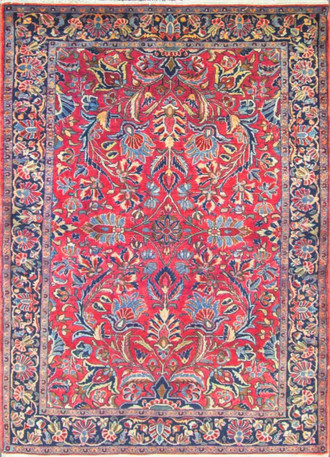
This exceptional antique Mohajeran Sarouk rug, measuring approximately 3'3" x 5' and dating to around 1920, is a superb example of the highly sought-after Mohajeran workshop weaving tradition rug. Mohajeran Sarouks are widely considered among the finest and most elegant Sarouk carpets ever produced, celebrated for their luxurious wool quality, refined drawing, and extraordinary decorative richness.
The rug displays a beautifully balanced allover floral composition set upon a luminous ruby-crimson field of remarkable depth and saturation.
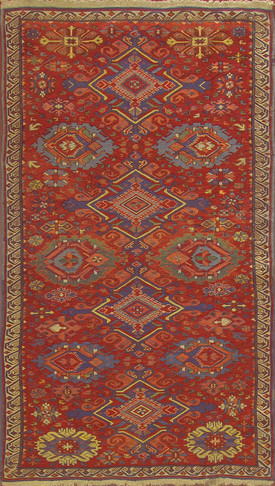
Antique Caucasian Soumak (Sumak) Kilim
Size: 3'5" x 6'1"
Origin: Caucasus (likely Shirvan / Kuba region influence)
Date: Circa late 19th.
Structure: Flatweave Soumak technique, wool on wool.
This is an exceptionally fine and visually striking antique Caucasian Soumak kilim, distinguished by its richly saturated color palette and highly articulated tribal drawing.
The field is dominated by a deep madder red ground, a hallmark of desirable Caucasian weavings, providing a warm and powerful visual foundation.
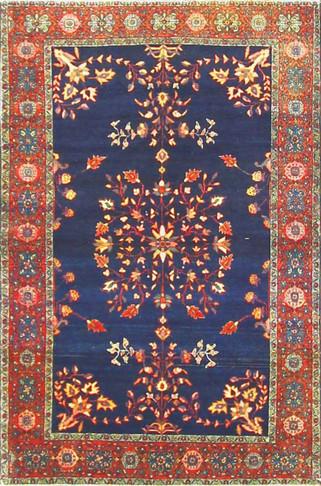
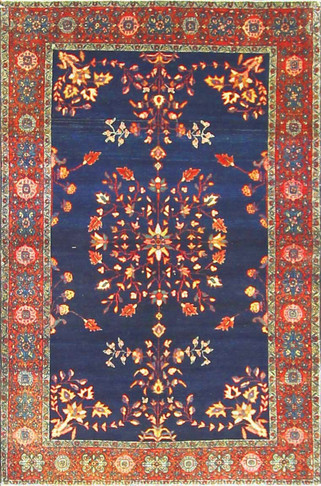
A beautiful and exceptionally fine antique Persian Feraghan Sarouk rug dating to circa 1890, distinguished by its unusual deep midnight-blue field, elegant floral drawing, and remarkable state of preservation.
The open navy-blue field provides a dramatic background for a finely articulated floral composition arranged around a delicate central flowering medallion. Graceful flowering branches, palmettes, leaves, and small blossoms extend vertically through the field while leaving generous open space around the design.