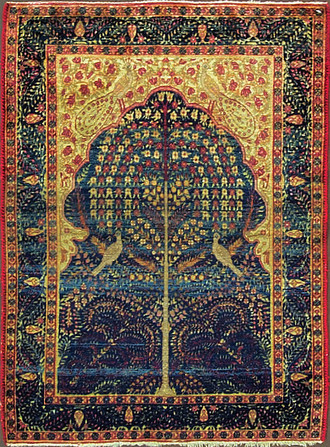
Pictorial rugs are some of the most over-the-top examples of the artistry, talent and determination needed to design and construct a fine, everlasting carpet.
Portraits of dignitaries, important officials and high-ranking people are also found in antique pictorial rugs. With the same token, weavers also choose to illustrate important scenes from history and literature.
Typifying pomp and circumstance, this Kerman carpet features a royal portrait.
Indulge in the legacy of exquisite craftsmanship with our captivating Aubusson tapestry, a testament to the centuries-old tradition of this artistry born in the heart of France. Nestled in the enchanting upper valley of the Creuse, the intricate process of weaving an Aubusson tapestry is a true marvel, a symphony of creativity and skill that produces resplendent decorative wall hangings, rugs, and even furniture pieces.
With a history dating back to the 16th century, Aubusson garnered renown for its lavish carpets and tapestries that graced royal residences.
Of large size, this finely woven Kurdish bag face from northwest Persia is a very collectable example of a well known format. It features the classic diamond design that is composed in an unusually sophisticated manner. It features a wide range of natural dye colors, including sky blue, light and deep coral and two shades of green. It retains the skirt and part of the end finish at the bottom and the much of the end finish at the top. The checkerboard outer guard border is a charming additional feature.
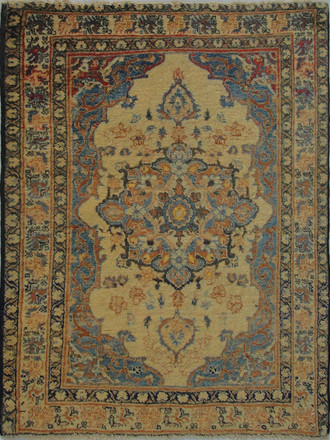
his exquisite antique Persian Hajji Jalili Tabriz rug is a miniature masterpiece that reflects the artistic genius of one of the most celebrated weaving traditions in Persia. Woven around 1880, it exemplifies the refined taste and extraordinary craftsmanship associated with the famed Hajji Jalili workshop, whose rugs are admired for their graceful drawing, delicate palettes, and exceptionally fine weave.
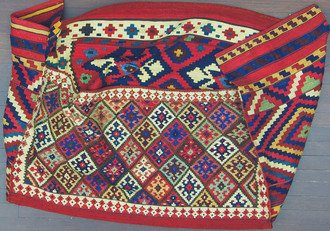
Azerbaijan cargo bag or Mafrash - Bedding Bags , the front, back and side panels woven in horizontal bands, the center of repeating blue, red and ivory hooked octagonal, within two geometric motif secondary borders.
Mafrash have been made in the largest numbers by Shahsevan tribal people and other groups in NW Iran and across the border in Azerbaijan. Others were made in Georgia and Armenia. A majority are intricately woven soumak; others are slit-tapestry, sometimes with narrow contrasting soumak bands.
The ivory field woven with vertical rows of blue and rose stepped medallions within a rose geometric border flanked by running dog variation guard borders.