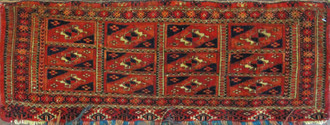
Embark on a journey through time as we unravel the rich history woven into the fabric of Turkmen rugs, a testament to the nomadic tribes that crafted these masterpieces centuries ago. In an era long past, these artisans relied on locally-sourced materials—wool from their herds and vegetable or natural dyes extracted from the bountiful land surrounding them. The result was a symphony of colors and patterns that reflected the unique identity of each tribe.
This rug is in excellent condition, cleaned and no stained, the ends and bindings of the rug are intact as original and there has not been any repairs. There are no tears, breaks or holes.
The materials are from vegetable dyes wool.
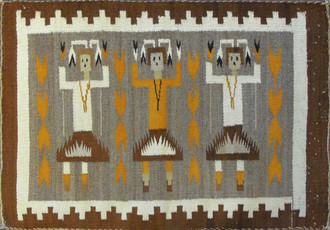
Handmade Navajo tree figure Yei rug. The weave is tight, the piece has a good weight and the design is clear with eleven different colors. The image is of three female Yei goddesses protected by a Rainbow Guardian. The rug was probably made in the early 20th century.
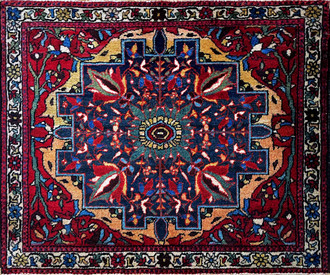
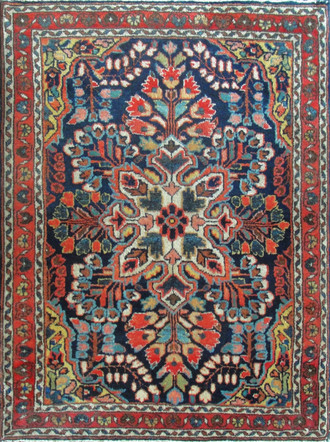
A charming and unusually small antique Feraghan Sarouk rug of fine quality, distinguished by its compact almost-square format and exceptionally strong central design.
The composition is dominated by a large stepped medallion on a deep midnight-blue ground, densely filled with finely drawn flowering vines, leaves and small blossoms.
One of the top high end Persian carpet maker.
The source of this important provenance has been in the village of Sarouk. North of Arak (formerly Sultanabad). Sarouks are known to be of high quality. The pile is usually higher than the average Persian rug and therefore Sarouks are rather heavy and solid rugs, the wool being used is high quality durable wool. "Mohajeran" or "Mahajiran" is the name of a village West of Arak.
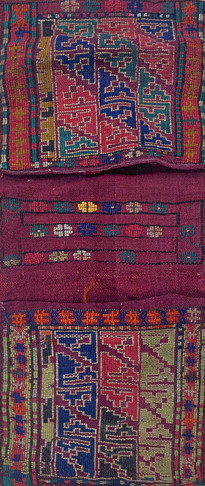
This charming antique tribal storage bag displays a bold and highly decorative geometric design characteristic of the nomadic weaving traditions of Northwest Persia and Eastern Anatolia. The bag is woven in richly saturated shades of madder red, aubergine, deep indigo, ivory, emerald green, saffron yellow, and rose, all harmoniously balanced against a dark wine-colored ground.
The front features a series of large stepped geometric medallions arranged in vertical panels, creating a powerful tribal composition.
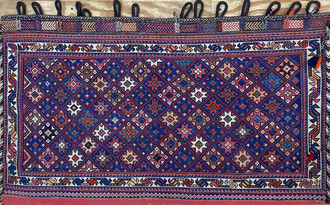
This outstanding antique tribal saddlebag is a beautifully woven example of early 20th-century nomadic craftsmanship, preserved in exceptional condition. The front panel displays an elegant lattice design composed of dozens of small diamond compartments, each enclosing stylized star and rosette motifs.