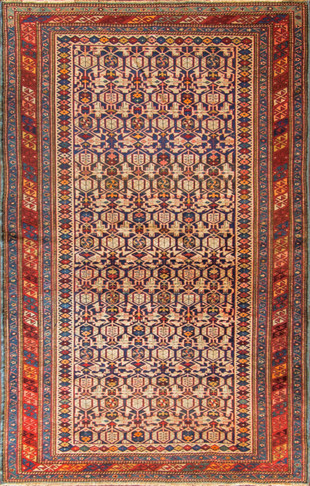
A finely woven Shirvan rug distinguished by its exceptional clarity of drawing and tight lattice design. The field is filled with orderly rows of stylized bird/tree motifs, rendered with precision on a warm ivory-gold ground.
The palette is vibrant yet refined, combining madder red, indigo blue, soft turquoise, and golden ivory, creating strong contrast while maintaining elegance. The borders are complex and well-articulated, framing the composition with crisp geometric rhythm.
This rug displays the bold geometric power for which Karachof Kazaks are celebrated. The composition is centered around a dramatic cruciform medallion rendered in deep indigo, ivory, sky blue, and madder red, surrounded by spacious open abrashed field areas that enhance the visual impact of the design.
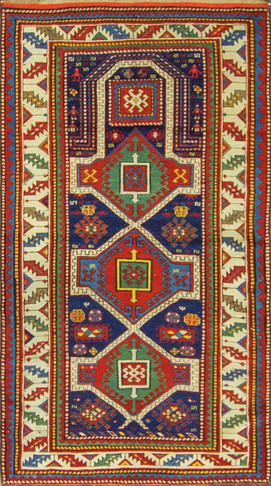
A finely drawn antique Fachralo Kazak prayer rug, featuring a classic stepped ivory mihrab and a vertical sequence of bold geometric medallions. The composition is crisp and well-balanced, combining strong tribal elements with refined spacing.
The palette includes ivory, deep indigo, madder red, and soft green, all well-preserved, creating excellent contrast and visual clarity. Multiple guard borders and a geometric main border frame the piece with precision.
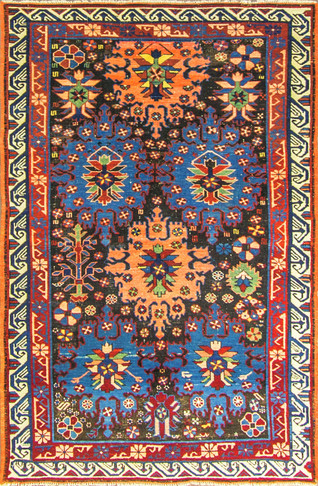
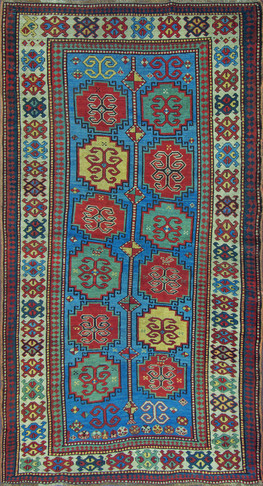
This is a particularly lively and unusual example. The field is organized around large, strongly drawn geometric floral forms in alternating areas of clear blue, soft salmon/coral, and dark brown-black, surrounded by numerous small rosettes, angular floral devices, and archaic-looking ornaments. The drawing has the spontaneous, almost playful quality that makes good early Caucasian village rugs so appealing.
The color combination is one of its strongest features. Brilliant blues, coral and salmon, deep red, ivory, soft green, yellow, and dark brown create a remarkably vibrant composition.
An exceptional late 19th-century Caucasian Kuba-Shirvan rug, measuring 4'5" x 6'10", distinguished by its unusually fine weave, sophisticated drawing, and remarkable state of preservation.
The ivory field is completely covered with an intricate all-over geometric floral lattice, composed of repeating angular blossoms, stylized leaves, rosettes, and small polygonal floral devices.
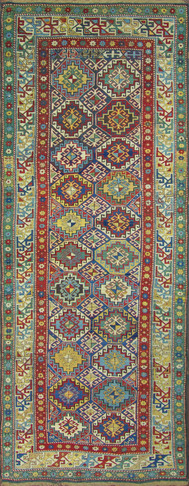
This outstanding antique Caucasian Shirvan rug is an exceptional late-19th-century tribal weaving, admired for its refined craftsmanship, brilliant vegetable-dyed colors, and striking geometric composition. Woven in the Shirvan region around 1880 or earlier, it exemplifies the artistic precision and fine weaving that distinguish the best Caucasian village rugs.
The field is composed of a rhythmic lattice of Lesghi Star medallions arranged in alternating colors of deep indigo, ivory, pale sky blue, celadon green, and soft golden yellow.
This striking late 19th-century Caucasian Kazak rug is an outstanding example of the bold tribal artistry that has made antique Kazaks among the most sought-after Caucasian weavings. Woven with exceptionally lustrous hand-spun mountain wool and natural vegetable dyes, the rug combines crisp geometry, vibrant colors, and a remarkably balanced composition.