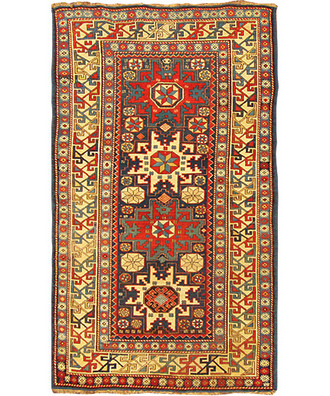
Origin: Southern Dagestan (Lesghi / Lezghi group)
Date: Circa late 19th century
Structure: Hand-knotted wool on wool.
A finely woven antique Lesghi rug, distinguished by its crisp drawing and classic all-over geometric lattice. The field features a vertical arrangement of octagonal rosettes and star-like medallions, closely associated with Lesghi designs, rendered with precision and clarity.
The palette is well-balanced, combining ivory, deep indigo, and madder red, with subtle secondary tones that enhance contrast and definition.
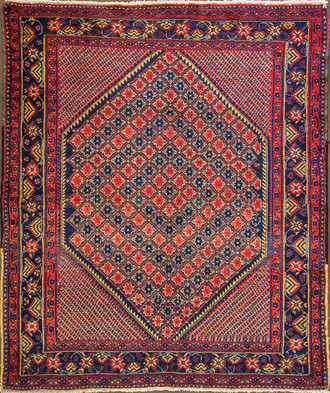
Antique Persian Bakhtiari Rug
Size: 4'7" x 5'7"
Origin: Western Persia (Bakhtiari region)
Date: Early 20th Century (circa 1900–1920)
Construction: Hand-knotted wool pile on cotton foundation
This finely woven antique Persian Bakhtiari rug represents a classic and highly decorative example of tribal village weaving from western Iran.
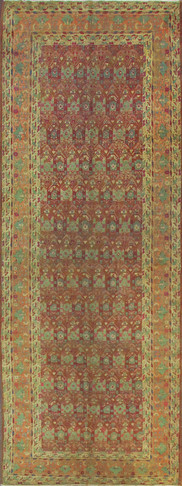
A gorgeous Agra gallery rug.
Agra is a large city and weaving district in North Central India that has been prolific in producing tightly knotted, decorative, floral rugs. Antique Agra rugs are renowned for their beauty of color, elegance of drawing and perhaps above all fineness of knotting. Agra colors are mostly red yellow green and ivory. The design is famous for its floral tendrils, angular vines and stars. Probably the most sophisticated carpet look with softness of visual impact to harmonize the atmosphere.
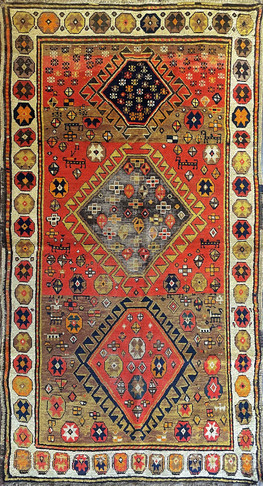
Antique Caucasian Kazak Rug
Size: 4'1" x 7'
Origin: Southwest Caucasus
Date: Late 19th Century
Construction: Hand-knotted Goat wool on wool foundation.
This late 19th-century Caucasian Kazak rug presents a compelling and highly individual interpretation of classic tribal design, distinguished by its intentional asymmetry, expressive drawing, and richly aged palette.
The field is anchored by a sequence of large geometric medallions, each uniquely rendered and enclosed within bold, serrated outlines.
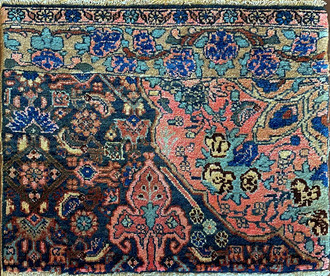
Ornak is a rug sampler, for corner of the rug.
Antique Kurdish rugs and bags are renowned for their distinctive patterns, vibrant colors, and high-quality craftsmanship.
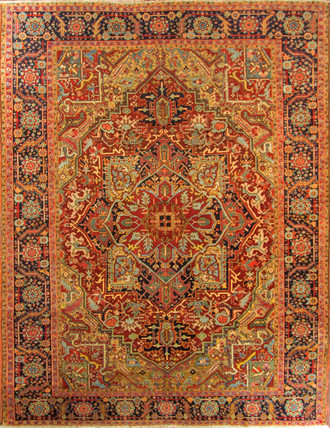
This remarkable and artistic antique rug showcases an ornate, multicolored central design. At the heart of the antique Persian Heriz Serapi rug, a many-petaled flower is surrounded by a 12-pointed stellar shape in light and dark blue. Angular stylized flowers stud the navy form and are echoed across the red medallion that encases it. Four ornaments decorate the corners of the medallion, and floral adornments nestle within each tip. A rust red field, brimming with botanical decorations, extends the medallion’s shape.
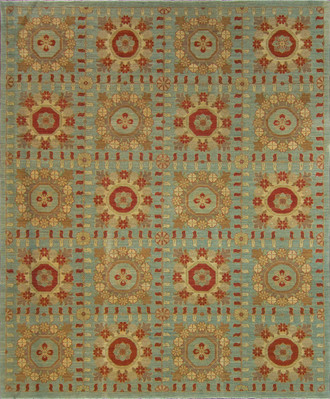
Vintage Savoriness Carpet — Light Pistachu with Sunburst Panel Design
This exquisite vintage Savoriness carpet from Pakistan is a beautifully balanced blend of timeless craftsmanship and striking visual appeal. Woven in a soft light pistachu color, this rug radiates a subtle vibrance that complements both modern and antique interiors with effortless sophistication.
The design features twenty large sunburst motifs arranged in a bold yet harmonious pattern — distributed across four vertical panels and five horizontal panels, creating a rhythmic and luminous composition that draws the eye.
Remarkable fine antique Persian Senneh Malayer galley size carpet, circa 1900 in excellent condition.
The tribal weavers in Malayer were often Turkish, and they employed the Turkish knot. The Gourde is a symmetrical knot, as opposed to the asymmetrical knot of many traditionally Persian creations. Additionally, antique Malayer rugs regularly enjoy a low cut pile. Weavers trimmed the pile in order to enhance the appearance of the design. In addition to a broad range of design and color, these rugs were designed technically to enhance the artistry of the woven design.