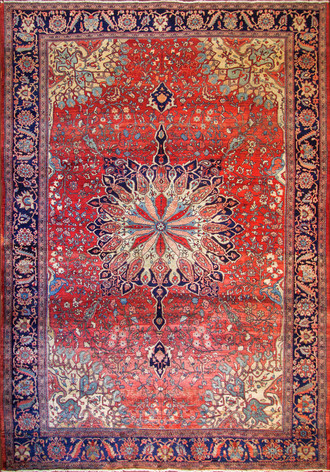
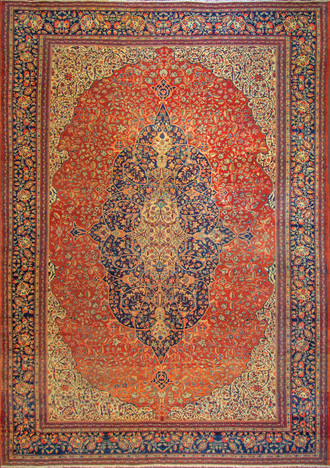
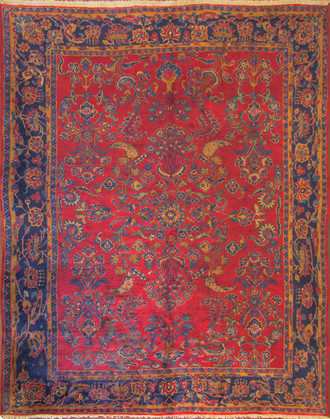
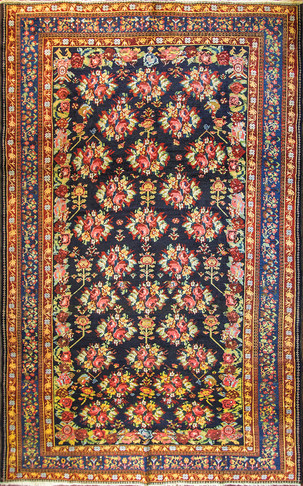
Feraghans were made between the 1870s and 1913 from a region north of the town of Arak, produced for the Persian aristocracy. They are single wefted, long and narrow or room-sized carpets, typically with an allover herati design or floral and curling leaf motifs. Feraghan-Sarouks, also called Sarouks, are double-wefted, heavier carpets with a higher knot count than village Sultanabads. Fields are often blue or ivory and designs typically feature either large medallions or representations of trees and birds
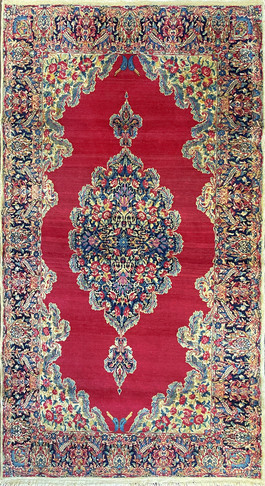
This elegant late-19th-century Persian Sarouk Feraghan carpet is a superb example of one of the most respected weaving traditions of Central Persia. Woven around 1880, it displays the refined artistry that distinguishes early Feraghan carpets from later commercial Sarouks. These carpets are admired for their fine weave, durable hand-spun wool, harmonious vegetable dyes, and graceful blend of village character with sophisticated workshop design.
The carpet is centered by an impressive elongated navy-blue medallion with an ivory centerpiece, resting on a rich terracotta-red field.
Sarouk, a small village and its neighboring villages in northwestern Iran are the source of large numbers rugs imported into the United States. The Sarouk carpet production came into existence around 1880 specifically for the European and North American markets. Before 1920s the Sarouk design was similar to that of the rug weaving centers of Ferahan and Tabriz. Most Sarouk rugs followed a very distinctive design and it depended on floral sprays and bouquets.
Mohajeran refers to another village where rugs are produced.
This beautiful antique Persian Bakhtiari carpet is a fine example of the distinctive village weaving tradition of the Bakhtiari tribes of southwestern Persia. Woven around 1920, it displays the superior craftsmanship, durable construction, and lustrous hand-spun wool that have made antique Bakhtiari carpets highly respected among collectors and decorators.
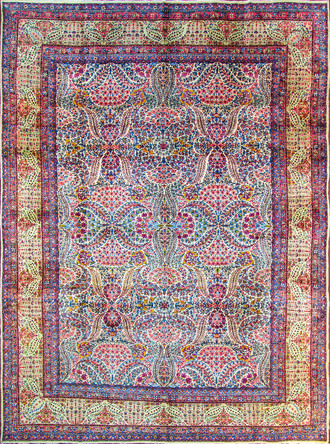
To the south east of Persia is the city of Kerman or Kirman and to the north of Kerman is the village of Laver or Raver which has a rug weaving history at least as long as that of Kerman. during the 1920s produce many rugs for the US market but the rugs been produce in this region since the sixteen century.
Antique Silk Turkish Rug, Turkey, Early 20th Century -- This outstanding Silk Turkish Rug reflects incredible care and attention to fine detail in its design and composition. Red, Brilliant green, yellow, , ivory colors permeate the visual imagery.associated with prayer, perhaps signifying the interconnections of life, scrolls throughout the border. Two elegant decorative guard borders set against ivory background present brilliantly colored red and green scrolling motifs.
This rug originally purchased from an nice estate in Park Ridge suburb of Chicago and was hanging on the wall
This elegant antique Persian Laver Kerman, woven circa 1920, is an outstanding example of the refined artistry for which the finest Kerman workshops became internationally renowned during the early twentieth century.
A superb antique Persian Bidjar rug, handwoven around 1920, representing one of the finest weaving traditions of western Persia. Known as the "Iron Rugs of Persia," Bidjars are celebrated for their extraordinarily dense weave, remarkable durability, and exceptional craftsmanship, making them among the most sought-after Persian rugs by collectors and decorators alike.
This beautiful example features a rich deep terracotta-red field filled with an intricate Herati (Mahi) pattern, centered by a striking geometric medallion in shades of ivory, navy, turquoise, and soft rose.