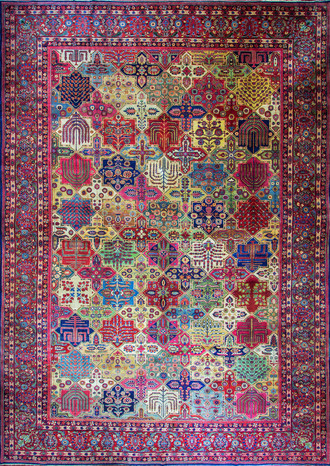
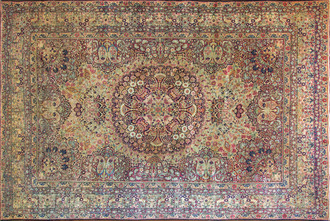
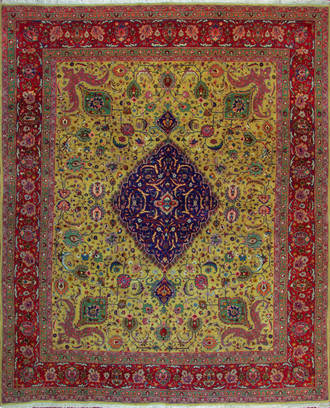
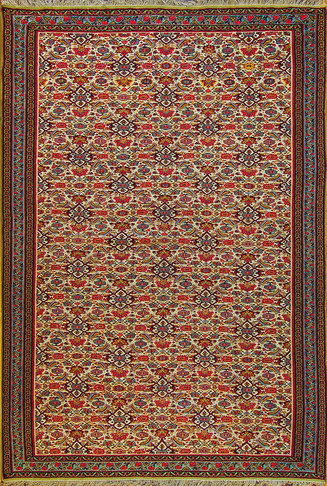
The rug has a harmonious design. Each symbol is very distinctive and refers to a specific aspect of life. The lay out provide a felling of inclusion. Regardless of where the viewer start he can easily migrate to the next symbol or just remain with last one. the design is uncommon for Feraghan sarouk and showing tree of life, riches and peace.
Sarouk carpets get their name from an obscure village in Persia, located twenty miles north of Arak (formerly Sultanabad).
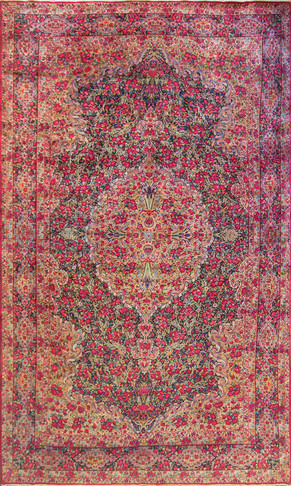
This elegant antique Persian Laver Kerman carpet is an outstanding example of the refined weaving tradition that made the Laver (Ravar) workshops of Kerman world-famous during the late 19th and early 20th centuries. Laver Kermans are regarded as the finest carpets produced in the Kerman region, distinguished by their exceptionally fine weave, velvety wool, graceful drawing, and sophisticated floral artistry.
The carpet displays a magnificent all-over floral composition centered around an elaborate ivory medallion that blends harmoniously into a densely ornamented midnight-blue field.
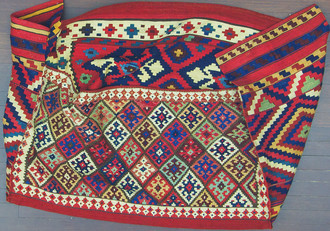
Azerbaijan cargo bag or Mafrash - Bedding Bags , the front, back and side panels woven in horizontal bands, the center of repeating blue, red and ivory hooked octagonal, within two geometric motif secondary borders.
Mafrash have been made in the largest numbers by Shahsevan tribal people and other groups in NW Iran and across the border in Azerbaijan. Others were made in Georgia and Armenia. A majority are intricately woven soumak; others are slit-tapestry, sometimes with narrow contrasting soumak bands.
The designs involve some repeat pattern, or diaper, the herāti, in which a diamond lattice pattern peeps through a tangle of blossoms and leaves or through intricate versions of the boteh, a leaf with curling, The rug is prized for his fine, delicate design and his distinctive, weaving technique. display a precise, crisp somewhat geometric drawing that corresponds to the precision of the weave. Colors tend to be varied and rich, but soft as well.
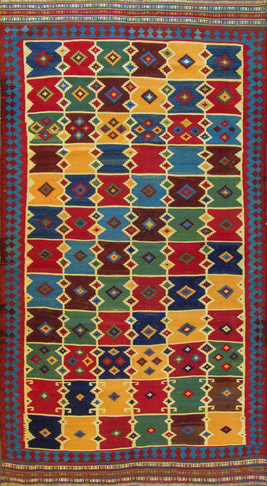
The polychrome field with horizontal bands of mustard, midnight blue, powder blue, green, and ivory rectangular motifs.
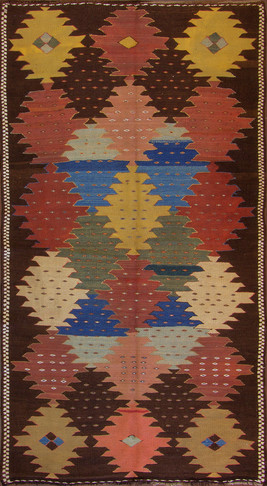
In the sixteenth century the predecessors of the Qashqai were in what is now the Azerbaijan/Iranian Azerbaijan area, they were a group of Oguz/Seljuq tribes that left the authority of the horde and They were related to the predecessors of the Shahsavan.