Repair and Conservation
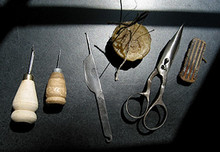
The Right Restoration Depends on the Rug's Age, Value and the Owner's Budget.
At Eli Peer Oriental Rugs, we believe that deciding how much repair or restoration should be performed is just as important as knowing how to perform the work.
With over 50 years of experience in the antique rug business, Eli Peer understands that every rug must be evaluated individually. Its age, quality, rarity, condition, current market value, intended use, and the owner's budget all play an important role in determining the appropriate treatment.
Not every antique rug requires extensive restoration, and the cost of repair should always be considered in relation to the rug's value and the customer's objectives.
Newer and Vintage Rugs — Practical Repairs Within a Reasonable Budget
For newer handmade rugs and many vintage carpets, the primary goal is to preserve their usefulness, improve their condition, and prevent further deterioration.
Repairing damaged edges, securing fringes, reinforcing weak areas, or addressing holes and tears may be sufficient to extend the rug's life for many years.
The recommended work should be practical, effective, and appropriate to the rug's market value and the customer's budget.
Antique Rugs — Preserving Character Without Unnecessary Expense
A rug that is 100 years old or older is not necessarily rare or exceptionally valuable.
Some antique rugs have considerable market value, while others are relatively modest in value despite their age.
In these cases, our recommendation is often to perform the repairs necessary to protect the rug from further deterioration without undertaking expensive restoration that may not be economically justified.
We believe that natural wear and signs of age should be respected. An antique rug does not need to look new to be beautiful, desirable, or worth preserving.
Our objective is to recommend the amount of repair that makes sense for both the rug and its owner.
Rare and Museum-Quality Rugs — Preservation Takes Priority
Rare, historically significant, and museum-quality rugs require a different approach.
For these exceptional pieces, the importance of preserving the rug's originality, artistic significance, and historical integrity may outweigh ordinary considerations of repair cost.
Extensive conservation work can sometimes require considerable time, specialized materials, and highly skilled craftsmanship.
For a truly exceptional museum-quality rug, there may be no predetermined budget limit, provided the work is necessary, appropriate, and carried out to the highest conservation standards.
However, expensive restoration is not always the correct solution. In some cases, minimal intervention and careful stabilization are preferable to extensive reweaving.
The objective is to preserve the rug's historical and artistic importance, not simply to improve its appearance.
Our Philosophy — The Right Repair at the Right Cost
Before recommending restoration, we consider what the rug is worth, what it needs, how it will be used, and how much the owner wishes to invest.
We explain the available options and the estimated costs, allowing customers to make informed decisions.
Sometimes a small repair is all that is necessary. Sometimes extensive restoration is justified. And sometimes the wisest recommendation is to leave an antique rug largely untouched.
The best restoration is not necessarily the most expensive. It is the work that is appropriate for the particular rug, its value, and its owner.
Traditional Antique Rug Repair and Restoration Services
At Eli Peer Oriental Rugs, we provide a wide range of professional rug repair and restoration services, including:
Repairing damaged fringes and securing the ends of rugs.
Restoring worn or damaged side cords and edges.
Repairing holes, tears, and weakened foundations.
Reweaving missing areas when appropriate.
Restoring damaged borders and corners.
Repairing damage caused by moths and other insects.
Stabilizing worn areas to prevent further deterioration.
Correcting certain curling edges and shape irregularities.
Evaluating and correcting inappropriate repairs performed in the past.
Whenever possible, we use traditional hand-repair techniques and materials compatible with the original weaving, including appropriate wool, cotton, silk, or goat hair.
All rug repair and restoration work is performed at our own facilities in Evanston, Illinois, or at our nearby warehouse.
We welcome customers to bring their rugs to our Evanston location or send photographs for an initial evaluation. We will explain the recommended work and estimated cost before proceeding.
Eli Peer Oriental Rugs
1501 Chicago Avenue
Evanston, Illinois 60201
Office: (847) 328-3281
Cell: (847) 226-0211
Email: peerantiquerugs@gmail.com
Website: www.peerrugs.com