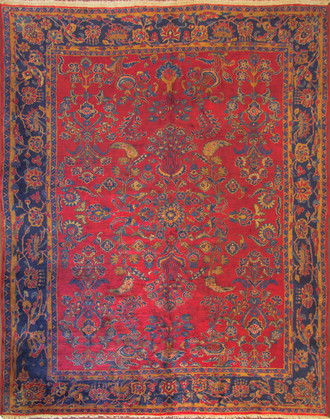
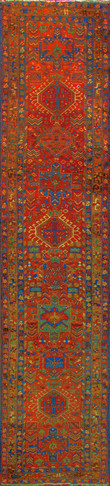
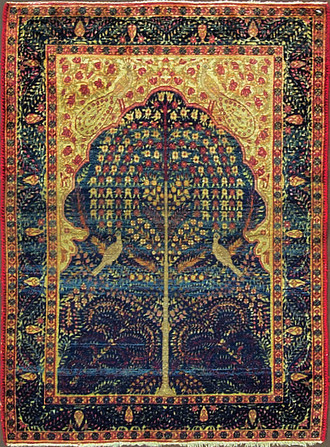
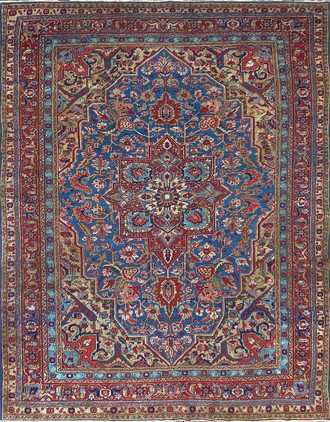
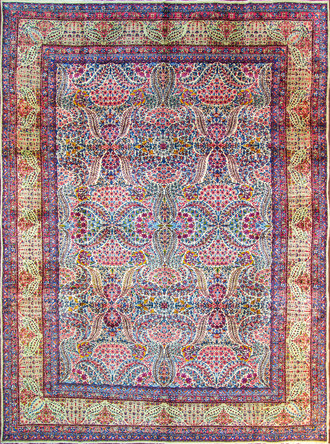
Sarouk, a small village and its neighboring villages in northwestern Iran are the source of large numbers rugs imported into the United States. The Sarouk carpet production came into existence around 1880 specifically for the European and North American markets. Before 1920s the Sarouk design was similar to that of the rug weaving centers of Ferahan and Tabriz. Most Sarouk rugs followed a very distinctive design and it depended on floral sprays and bouquets.
Mohajeran refers to another village where rugs are produced.
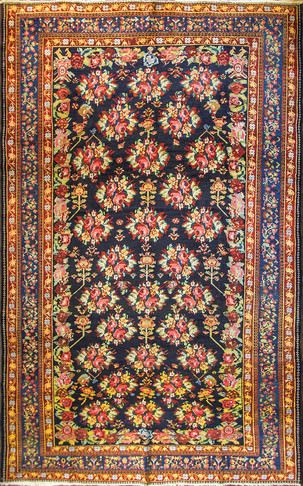
This beautiful antique Persian Bakhtiari carpet is a fine example of the distinctive village weaving tradition of the Bakhtiari tribes of southwestern Persia. Woven around 1920, it displays the superior craftsmanship, durable construction, and lustrous hand-spun wool that have made antique Bakhtiari carpets highly respected among collectors and decorators.
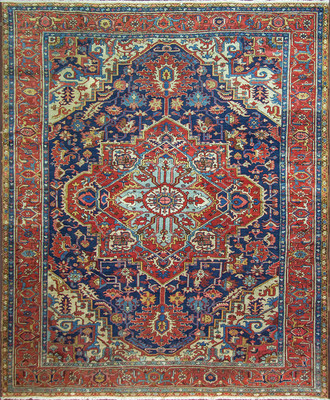
This exceptional late 19th-century Serapi carpet represents one of the most admired village weaving traditions of Northwest Persia. Distinguished by its bold architectural drawing and refined craftsmanship, the carpet features a commanding geometric medallion set against a rich midnight-blue field, framed by ivory corner spandrels and a beautifully proportioned coral-red border.
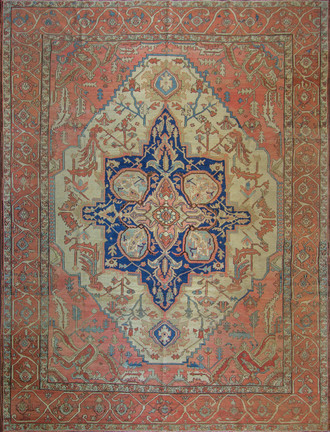
A handsome and highly decorative late 19th-century Persian Serapi carpet, circa 1880, distinguished by its spacious drawing, strong architectural medallion, and beautifully softened natural color palette.
The composition is centered by a dramatic deep indigo-blue geometric medallion, surrounded by an expansive ivory ground and framed by warm salmon, coral, and terracotta tones.
Antique Persian Heriz/Serapi, hailing from the Iranian province of Eastern Azerbaijan and the encompassing Heriz region, hold a rich tapestry of history and craftsmanship. The village of Serab, nestled to the south of the Heriz region in North West Persia, is the venerable birthplace of these exquisite rugs.
Serapi, a term often reserved for the most exceptional antique rugs from the Heriz vicinity, has carved out a distinct niche in the world of rug connoisseurs.
To the south east of Persia is the city of Kerman or Kirman and to the north of Kerman is the village of Laver or Raver which has a rug weaving history at least as long as that of Kerman. during the 1920s produce many rugs for the US market but the rugs been produce in this region since the sixteen century.