Antique Heriz and Serapi Rugs: A Dealer’s Guide to History, Design, Quality and Value
Antique Heriz and Serapi Rugs
Antique Heriz and Serapi carpets have long been among the most recognizable and desirable Persian rugs. Their bold geometric drawing, beautiful colors, excellent wool, and durability have made them favorites with collectors, interior designers, and homeowners for generations.
I have been dealing in antique Oriental rugs for many decades, and during that time I have handled a great number of Heriz and Serapi carpets. Although the names Heriz and Serapi are sometimes used almost interchangeably in the marketplace, there can be considerable differences in age, quality, drawing, color, and value.
No two antique examples should be judged simply by their name. Each carpet needs to be examined individually.
Where Do Heriz and Serapi Rugs Come From?
Heriz carpets are associated with the Heriz weaving district of northwestern Persia, an area with a long tradition of producing strong, durable carpets distinguished by angular geometric drawing.
The rugs generally use a symmetrical knot and a sturdy construction. Many were woven in substantial room sizes, which is one reason antique Heriz carpets remain so practical for today's interiors.
The term Serapi requires a little more care.
In today's antique rug trade, “Serapi” is generally used for a group of particularly desirable older carpets associated with the broader Heriz weaving tradition. The terminology has been debated by rug scholars and dealers, and it should not be treated as though Serapi were simply one precisely defined village production.
In the marketplace, the name is most often associated with earlier, finely drawn examples displaying beautiful colors, relatively spacious designs, and a particularly appealing balance between geometric strength and artistic refinement.
What Makes a Serapi Different?
There is no single design that defines every Serapi.
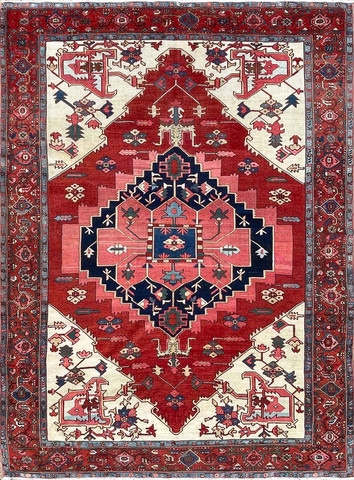
Many examples feature a large central medallion surrounded by angular floral and geometric elements. Others can have more elaborate medallions, multiple layers of drawing, large corner spandrels, or unusually spacious fields.
One quality I particularly look for is balance. The finest examples can be powerful without being crowded. Large motifs have room to breathe, and the irregularities of hand drawing give the carpet individuality and character.
Color Is Extremely Important
One of the greatest attractions of antique Serapi carpets is their color.
Rich madder reds and terracotta tones may be combined with deep indigo blue, lighter blues, ivory, salmon, soft greens, and warm yellow or gold tones. With age, these colors can develop a softness and harmony that is extremely difficult to reproduce.
Abrash—natural variations of color occurring within the field or individual areas of a handwoven rug—can also contribute considerable character and should not automatically be considered a defect.
How I Examine an Antique Serapi
After handling antique rugs for many years, I do not identify or evaluate a Serapi from its design alone.
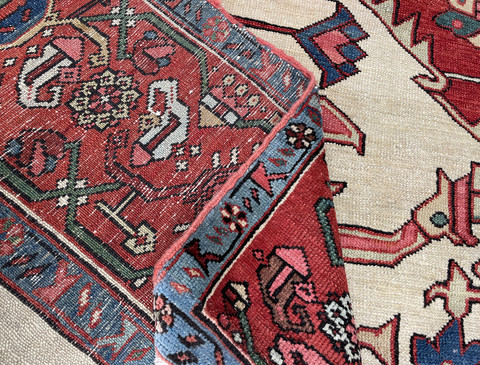
I look at the carpet as a whole: its wool, weave, foundation, drawing, colors, pile, sides and ends, repairs, and overall condition. I also examine the back.
The reverse of an antique carpet can reveal characteristics of the weave and construction that are much more difficult to understand from the face alone.
Experience is particularly important because no single feature proves that a carpet is a Serapi or determines its age. Design, construction, materials, color, and wear have to be considered together.
Age and Condition
Many of the Serapi carpets most highly valued by collectors date from the nineteenth century, particularly the second half of the century, although dating an individual carpet should always be done carefully.
Condition is important, but with an antique rug, perfect condition is not always the most important consideration. An exceptional nineteenth-century carpet with honest, even wear may be much more desirable and valuable than a younger example in nearly perfect condition.
Old restoration is not necessarily a serious problem. The important questions are how extensive it is and how well it was done.
What Determines the Value of a Serapi?
There is no reliable price formula based simply on size and age. Two Serapi carpets of similar dimensions can have dramatically different values.
Quality of drawing, color, age, rarity, condition, size, wool, and overall artistic presence all contribute to value. A particularly beautiful nineteenth-century Serapi with outstanding color and unusual drawing can command considerably more than an ordinary example bearing the same general name.
This is why I believe an antique carpet should always be judged individually rather than solely by its label.
Decorating With Antique Heriz and Serapi Carpets
One reason these carpets have remained popular for so long is their extraordinary versatility.
They can be equally successful in a traditional home surrounded by antiques or in a contemporary interior with simple furniture and clean architectural lines. The geometry provides structure while the irregularities of hand weaving and naturally aged colors bring warmth and character.
Large examples work particularly well in living rooms, dining rooms, libraries, and entrance halls.
Caring for an Antique Heriz or Serapi
A good antique carpet was made to be used, but proper care is important.
Regular gentle vacuuming, a suitable rug pad, protection from prolonged moisture, and professional washing when necessary can help preserve a carpet for many years.
Repairs should be approached conservatively. Whenever possible, restoration should respect the original structure, materials, and character of the rug rather than making an old carpet look artificially new.
At Eli Peer Oriental Rugs, we have many years of experience with antique rug cleaning, restoration and repair, as well as helping clients select antique carpets appropriate for their homes.
Experience Matters
Photographs can tell us a great deal about an antique rug, but they cannot tell us everything. The feel of the wool, flexibility of the carpet, construction, pile, repairs, color, and many other characteristics are often best understood through physical examination.
After decades of buying, selling, studying, and handling antique Oriental rugs, I still believe every carpet deserves to be looked at individually.
That individuality is one of the reasons antique Heriz and Serapi carpets continue to fascinate collectors and remain so beautiful in homes today.
Eli Peer
Eli Peer Oriental Rugs
Evanston, Illinois